Tuesday, 10 April 2012

The River Kaveri is the sacred river of India and holds the special religious importance. People in India considers river Kaveri as Goddess and worship it. (aveholidayhome.com)


Origin of the River Kaveri

River Kaveri originates in the Brahmagiri hills in Kodagu, in a place called Talakaveri. It starts its journey from the small pond called as Kundike pond, later the two tributaries known as Kanake and Sujyoti joins it. All these three rivers meets at the point called Bhagamandala. It lies at an altitude of 1350 meters and generally flows from the south to eastward direction. The river is approximately 760 km long. Its flows in the state of Karnataka and Tamil Nadu and merges into Bay of Bengal.


Story of Popularity behind River Kaveri: There are many different stories behind the birth of River Kaveri. One of them goes as such- In the ancient times the condition of the south India was becoming worse due to the severe drought in the area. Watching this sage Agastya felt very sad and prayed to the Lord Brahma to help the mankind to come out of this situation. Brahma said if you go to the place where Lord Shiva lives and collect some of the snow water that never ends, than you will be able to start a new river. Rishi Agastya went to the mount Kailash and filled his pot with the snow water and went back. He started searching for the good place to start the river in the hilly Coorg region. He became tired searching for the right place and handed his pot to the small boy who was playing there. That little boy was actually Lord Ganesha who selected the place to start the river and slowly put the pot down and disappeared. After some time Agastya called out – Little boy what do you think. He got no answer. Soon he noticed a crow spilled the pot of snow water on to the ground. After some time Lord Ganesha appeared instead of crow with the smiling face.

Religious Importance: The river Kaveri is the sacred river of India and holds the special religious importance. People in India considers river Kaveri as Goddess and worship it. She has been referred o as the Goddess Kaveri Amman. According to the legends she purifies our karmas and washes away all our sufferings. She is the Universal mother and is believed to give us peace.

Other purpose of the Kaveri River: The river Kaveri has been supporting the large amount of wildlife. Millions of people in south India are heavily dependent on its water especially the tribal population. Its water is widely used for the purpose of irrigation and for the power supply. The hydroelectric plant built on the left Sivanasamudra Falls on the Kaveri, was the first hydroelectric plant in Karnataka.


Contact Detail
AVE Beach Resort
Veerabagupathy,
Chothavilai beach,
Thengamputhoor,
Kanyakumari.
Call
Tel No: 04652 221337
+91 8220099080
Email: aveholidayhome@gmail.com

Monday, 9 April 2012

The river brahmaputra is one of the major river in the world. It originates from Mansarovar near Mount Kailash in the Himalayas, flows via Tibbet, China. (aveholidayhome.com)


River - Brahmaputra


The river brahmaputra is one of the major river in the world. It originates from Mansarovar near Mount Kailash in the Himalayas, flows via Tibbet, China, India and Bangladesh to Bay of bangal. The total length it travels from Himalayans to the Bay is 2900 Km. 
The Brahmaputra from Bhumuraguri Bridge
In Tibbet the river is known as 'Tsangpo'. It follows the great Himalayans in its course till India with an avergae height of 4000 meters. It joins with other two giant rivers, Dibang and Lohit. There are many tributaries which joins Brahmaputra on both northern and southern bank of


the river in Assam. With all its tributaries, the river creates the fertile Brahmaputra Valley of Assam. After Assam Brahmaputra enters Bangladesh where it flows for 240 kms to meet Ganges. It is called Jamuna there and finally flows into the Bay of Bangal. The Brhmaptura river is the lifeline of the all the people living in Assam and Bangladesh.

Some interesting facts about Brahmaputra:
  • In the Tibet and Himalayan region, Brahmaputra flows at an average height of 400 eters for 13000 kms. This highest for any major river in the world.
  • The mighty Brahmaputra is supposed to be one of the most powerful river in the world. Based upon the flow rate, Brahmaputra is the fifth strongest river in the world.
  • The Brahmaputra is one of those very few major rivers in the world which exhibit 'tidal bore'. It means incoming tides form waves that travel up the river against the direction of the current. This is what called a true 'tidal wave' in geography. This is one of the reasons behind Brahmaputra's enormousstrength.
The Mighty Brahmaputra
  • 'Majuli', the largest island created by a river also resides in the Brahmaputra. This river island is situated in Assam and around 100 km in length.
  • The Brahmaputra along with Ganges creates the largest delta in the world, Sundarban in Bangladesh.
  • The average width of Brahmaputra is close to 10 km in plains which is on the widest in the world.
  • Where Brahmaputra enters India is till date on the most remote and adventurous part of the world. The river flows rapidly down to the plains from a height of 4000 meters in this region. This unknown region had trapped imagination of British for many decades in 19th century until it was discovered.
  • The rivers are considered to be female in India. But the Brahmaputra is the only male river in India.


AVE Beach Resort
Veerabagupathy,
Chothavilai beach,
Thengamputhoor,
Kanyakumari.
Call
Tel No: 04652 221337
+91 8220099080
Email: aveholidayhome@gmail.com

Saturday, 7 April 2012

it is hotter during the summer, colder in winter, and somewhere in between during spring and fall. These are the seasons, a regular change in temperature, that repeat them every year, more or less regularly. (aveholidayhome.com)


Season’s reasons


Unless you live near the Earth's equator, you have no doubt noticed that the weather changes during the year: it is hotter during the summer, colder in winter, and somewhere in between during spring and fall. These are the seasons, a regular change in temperature, that repeat them every year, more or less regularly.


What causes these changes? The Sun is our main source of heat, and since these changes are the same every year, it surely has something to do with the movement of the Earth around the Sun. If we get closer to a fire, we get hotter. Could it be then that the Earth gets closer to the Sun during summer and farther during winter?  This idea seems at first to have some merit, until we remember that the seasons get reversed when we cross the equator: when it is summer in the northern hemisphere, it is winter in the southern one, and vice versa. And surely Argentina is at the same distance from the Sun as the USA!

Besides, that the Earth's orbit is an ellipse, not a circle, so that at some times the Earth is closer to the Sun than at others; but this ellipse is very nearly a circle, and the relatively small differences in distance to the Sun cannot account for the changes in temperature. And to make things worse, the Earth is closer to the Sun during the northern hemisphere winter!

What, then, is the cause of the seasons?


In the above animation, you can see the Earth during one full year (the animation then starts over again), as you would if you looked straight at it from the Sun. As you can see, the part of the Earth that is directly facing the sunchanges with the time of the year. It is the northern half for a while, then moves south of the equator, only to move back to the north again.


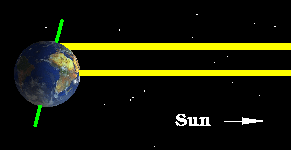
What causes this? The Earth rotates around an imaginary line passing through the poles, called the axis. This line forms an angle of 23.4° with the perpendicular to the orbit of the Earth around the Sun.

What has this to do with temperature? Well, when the northern hemisphere is leaning away from the sun, the rays coming from it hit this part of the Earth at a smaller angle than on other parts of the world. This means that the same amount of light is distributed over a larger surface, and therefore these places receive less heat than the others. The southern hemisphere is experiencing summer, the northern hemisphere winter. In half a year, the situation reverses, and it is now winter in the southern hemisphere since that part of the earth is now leaning away from the sun.

The seasons are then the result of this tilt of the Earth's axis. If the tilt of the Earth's axis was 0° there would be no difference in how the rays from the sun hit its different regions, and there would be no seasons.


AVE Beach Resort
Veerabagupathy,
Chothavilai beach,
Thengamputhoor,
Kanyakumari.
Call
Tel No: 04652 221337
+91 8220099080
Email: aveholidayhome@gmail.com

Thursday, 5 April 2012

Autumn is a season filled with change. Days become shorter and, although it is often warm and sunny during the daytime, it can be cold at night. In Autumn, leaves fall off the trees and hedges. (aveholidayhome.com)


Autumn Season

Autumn, also termed as "fall" in North America is an intermediary phase in between summer and winter. Autumn is a specific season in the temperate zone. The end of summer signifies the arrival of autumn. Autumn is characterized by mellowness. Autumn leaves have a reddish tinge which falls away during this season thereby paving the way for further growth.

 Autumn Season
Autumn commences in the month of August or September in the north, while in the southern part, the season of autumn arrives in the month of March. This is a time when trees get rid of 


their old look in the process of shedding leaves. All these year, a particular belief has prevailed among the astrologers that September Equinox indicates the beginning of autumn 


which end with the December Solstice in the northern parts of the world. In the southern part, the arrivalof autumn is indicated by the March Equinox and ends with the June Solstice.

Essence of autumn
Autumn was also known as the harvest season in the earlier days. It is so because this season provides the ideal conditions for harvesting crops, fruits and vegetables. Wheat ripens during 


this season. In fact in United States, the famous harvest celebrations takes place during autumn. Autumn also signifies the Halloween season in United States. However, this season 

also has a melancholic overtone. Over the period, several meaningful poems have been written providing brilliant definition of the season. But John Keats's 'The Autumn' most beautifully grasps the essence of this Season.


AVE Beach Resort
Veerabagupathy,
Chothavilai beach,
Thengamputhoor,
Kanyakumari.
Call
Tel No: 04652 221337
+91 8220099080
Email: aveholidayhome@gmail.com 

Wednesday, 4 April 2012

Summer is something we usually all look forward to. The days become both warmer and longer, the sun shines, and the school holidays provide us plenty of time. (aveholidayhome.com)


Summer season


Going from March to June, the summer season is the hottest time in most of the parts of India. The most hectic season of this tropical country, summer scorches almost all the parts of India with sweltering heat. Hot winds and scorching sun are the two most inseparable constituents of Indian summer. Light cotton clothes remain the order of the day to protect you of the prickly heat of Indian summer.

In some of the hilly and desert areas, water too becomes a scarcity during summer. The month of June is the hottest month of the year in India when temperature crosses even 45 degrees. It is not advisable to the tourists to visit the country during summer for the fear of various infections and ailments like Cholera and diarrhea.

But, if it is unavoidable, do remember to eat light and stay light during summer in India. It is suggested not to eat out at the local eateries for the fear of infections. It is suggested to carry lemonades with you all the times. A sunscreen lotion is a must irrespective of the time you are going out for. Avoid going out in the sun if possible for you can get severe sunburns.

Characteristics of summer
Summer is generally known to be the season which has the hottest and longest days in a year. The summer nights are usually smaller than those of winter. It is a very good season for outdoor activities like vacationing, swimming or simply lazing on the beach. Various tropical summer fruits like pineapples, watermelons, mangoes, berries, melons, and vegetables are abundant in summer.


Summer
Summeris something we usually all look forward to. The days become both warmer and longer, the sun shines, and the school holidays provide us plenty of time to go out and enjoy ourselves. Although sunny weather is very fun and we can spend more time outside, the sun's rays can harm our bodies. There are some things you need to do to protect yourselves. You shouldn't ever look straight at the sun because it will damage your eyes. Additionally, you have to protect your skin from the suns rays so that you don't get sunburned. Summer weather can vary, but if we are lucky, June, July and August will bring some warm sunny days.


AVE Beach Resort
Veerabagupathy,
Chothavilai beach,
Thengamputhoor,
Kanyakumari.
Call
Tel No: 04652 221337
+91 8220099080
Email: aveholidayhome@gmail.com

Tuesday, 3 April 2012

Spring is the time when nature renews its self. This is also a great time to renew your lawn and landscape and prepare it to look its best. (aveholidayhome.com)


About Spring Season


Spring Season is a particular type of season that is experienced in the temperate climatic zones. Spring is an intermediate seasonal phase in between winter and summer. Spring signifies the emergence of new life. Spring months are the blossoming months that bring meaningful growth and rejuvenation in its wake. Spring enriches natural beauty and it seems as if nature is dressed in a beautiful green gown.


This season arrives during different parts of the year in the North and South of the world. Places, which are situated in the north experience the spring season from March to May while 

in the southern part of the world, September to November is the springtime. Vernal Equinox indicates the arrival of spring season while the Summer Solstice announces its departure.

Important Features of spring
Extreme weather conditions characterize the spring season. This is due to the fact that during this season the warm winds coming from the lower regions are accompanied by the cold air 

which originates from the Polar Regions. During the spring season, days are longer and the weather is severe. The seas and rivers are full because the snow begins to melt. Rainfall is also 

heavy often leading to serious flood situations. Floods are most common in the hilly areas. In addition to all this, tornado, hailstorms and heavy downpour are also common features during the spring season. In fact, end of spring is the time when hurricane arrives almost without any warning.


AVE Beach Resort
Veerabagupathy,
Chothavilai beach,
Thengamputhoor,
Kanyakumari.
Call
Tel No: 04652 221337
+91 8220099080
Email: aveholidayhome@gmail.com

Monday, 2 April 2012

The winter season comes after the rainy season. It begins from november and lasts till the end of january. It is pleasant season. (aveholidayhome.com)


Winter Season


Winter is the coldest season of the year and it is a part of the main seasons found in the temperate zone. In general, winter is characterized by having minimum temperatures and the days of the shortest duration.

Duration of winter
The official start of the month of winter is different in various cultures and locations. According to recent meteorology the winter months are December, January and February for the Northern Hemisphere. For the Southern Hemisphere they are June, July and August. Even so, many European and East Asian nations regard November as the start of the winter season. The Celtic countries consider November 1 as the beginning of winter whereas according to the Chinese calendar it is from November 7.

Features of winter
  • The winter nights are usually very long and the days are short.
  • In certain areas, there is extremely high precipitation in the form of snowfalland some places remain permanently covered with snow.
  • In places where there are blizzards or winter storms a lot of transportation problems are faced.
  • Ice fog is a rare atmospheric phenomenon, in which suspension of ice crystals is formed in the air. This happens only at temperatures that follow below -30ÂșC.

Winter activities

There are a number of fun sports and interesting activities associated with winter. To name a few we have:
  • Iceskating
  • Ice Hockey
  • Ice Biking
  • Skiing
  • Snowball fighting
  • Building snowman and snow castles
  • Sledging


Winter is a season which occurs between autumn and spring.

The winter season has several advantages. It gives us a lot of fruits and vegetables. It is good for health. It is suitable for hard work. We do not get tired soon. Students like this season because they can work hard during this season. They play cricket, hockey and badminton during this season. The winter season improves our health. Our digestion improves during this season. We look energetic and smart in this season. The winter evening is very pleasant. It is delightful to sit round the fire in the evening and chat with friends.

The winter season is very painful for the poor. The poor people do not have warm clothes. They shiver with cold at night. It is difficult for them to sleep at night. Many people die from cold. It is difficult to go out at night. We often catch cold during winter.


AVE Beach Resort
Veerabagupathy,
Chothavilai beach,
Thengamputhoor,
Kanyakumari.
Call
Tel No: 04652 221337
+91 8220099080
Email: aveholidayhome@gmail.com